An ibis bird might be smaller or different than an oriole is, but if you’re wondering what is an ostrich like bird, that’s a totally different type of bird. a medium-sized songbird best known for its striking black-and-orange plumage, at least in the males. If you spotted a bold, flame-colored bird with black wings at your feeder or in a tall tree and wondered what it was, there's a good chance you've found an oriole. The three species most North Americans encounter are the Baltimore Oriole, the Bullock's Oriole, and the Orchard Oriole, and while they share a family resemblance, each has specific field marks that make them identifiable once you know what to look for.
What Does an Oriole Bird Look Like? Males vs Females

Marcus Whitley
22 Mar 2026
Quick ID: what an oriole actually is
Orioles in North America belong to the genus Icterus, which puts them in the same family as blackbirds and meadowlarks, not the Old World orioles of Europe and Asia. When most people in North America say 'oriole,' they mean one of the Icterus species. These birds are cavity-nesters that build remarkable hanging, sock-shaped nests from woven fibers, and they're most often seen in open woodlands, parks, and backyards during spring and summer breeding season. The overall impression is a compact, strong-billed songbird with vivid contrast between black and warm orange or chestnut tones, at least in the adult males.
Body size, shape, and general color
Orioles are medium-sized songbirds, roughly the size of an American Robin but built a bit more compactly, with a thick neck, longish legs, and a sturdy, sharply pointed bill. That bill is one of the first things worth noticing: it's not stubby like a finch's or flat like a flycatcher's. It's long, straight, and tapers to a fine point, which helps separate orioles from a lot of other birds at first glance.
The overall color scheme depends on the species, but the pattern is consistent: adult males show sharp contrast between black upperparts and warm underparts (orange in Baltimore and Bullock's, chestnut in Orchard Orioles). The wings are black with white markings, the tail is black, and there's virtually no mottling or streaking on the body. Females and immatures look quite different, which is where a lot of the confusion happens.
Male vs female oriole: the differences that matter
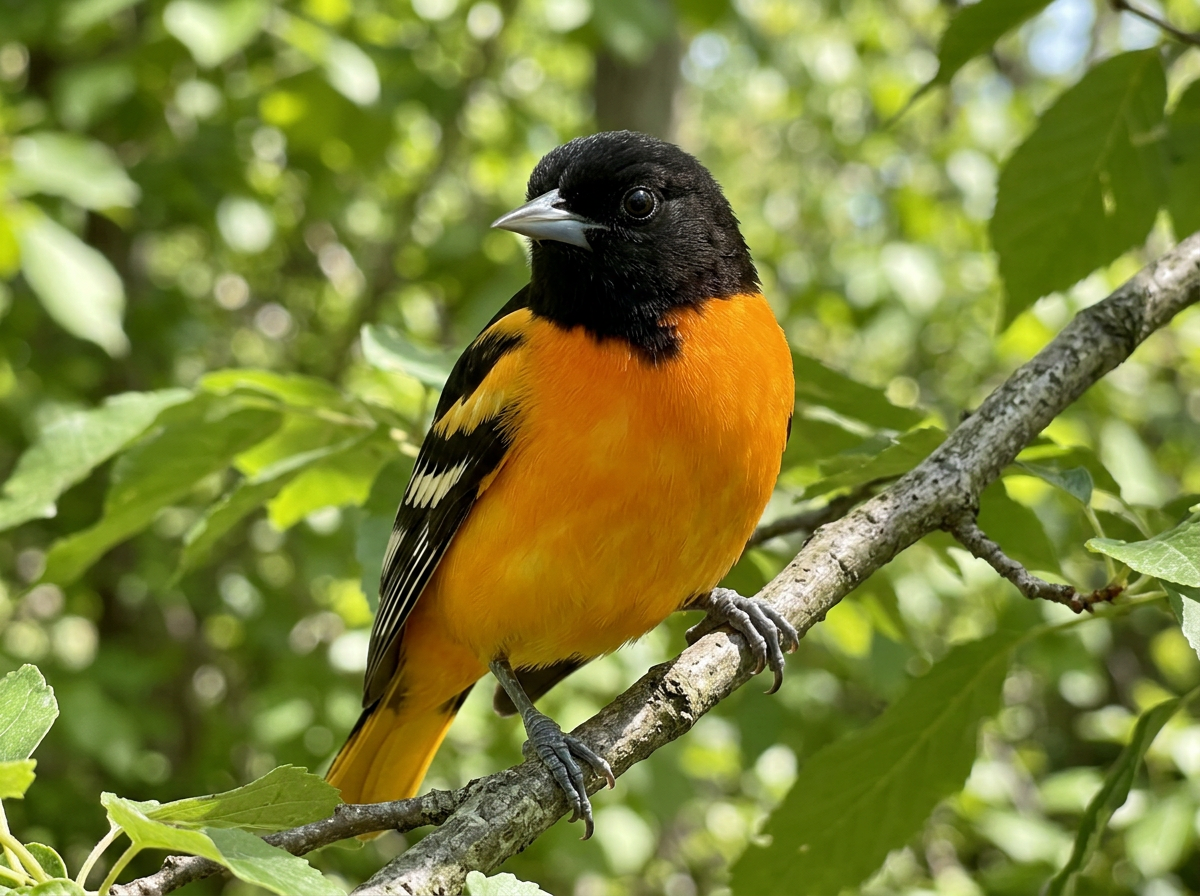
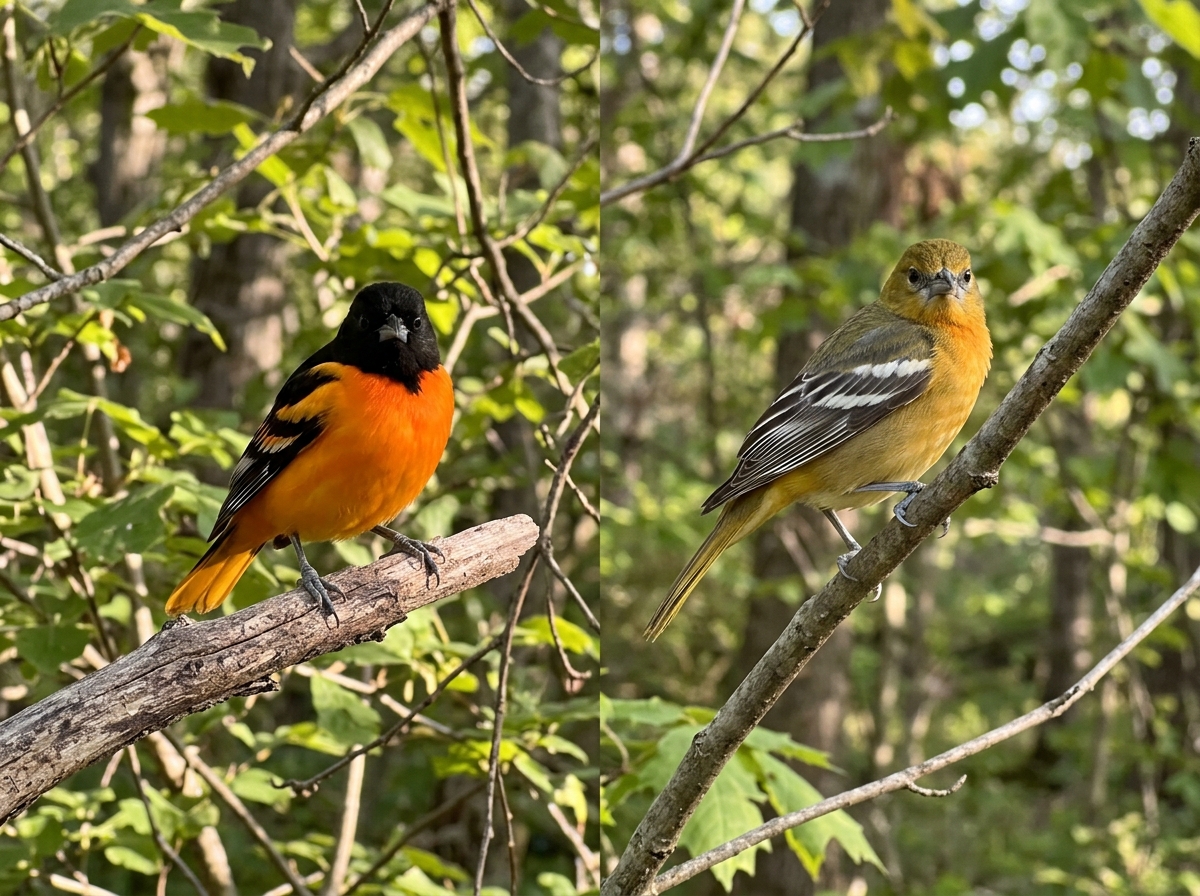
The male Baltimore Oriole is one of the most visually striking birds in North America. He has a completely black head (a solid 'hood' covering his entire head, throat, and upper back), with rich, flame-orange underparts and an orange patch on the shoulders and rump. His wings are black with a single thin white wing bar. That fully black head is actually a key separator: if you see an orange-and-black bird with a solid black head, no orange or white on the face at all, you're almost certainly looking at a male Baltimore Oriole.
Female Baltimore Orioles look like a softer, muted version of the male. The head and back are brownish to olive-brown rather than black, the underparts are a warm yellow-orange rather than the male's vivid flame-orange, and the wings show two bold white wing bars instead of the male's single thin one. The variable black on a female's head is one of those features that can confuse beginners: some females show a bit of dark patterning on the face, others barely any. If you see a drab olive-brown bird with two white wing bars and a yellowish-orange chest, that's your female Baltimore.
Bullock's Oriole males have a different face pattern entirely. Instead of a solid black hood, the male Bullock's has a bright orange face with a black eye line running through it and a black cap on top. The wings show a large, solid white patch rather than a narrow wing bar. Female Bullock's have a yellowish-orange head, a grayish back, a whitish belly, and white wing bars. They can look similar to female Baltimores, so the head and wing patterns are worth examining carefully.
Orchard Orioles are the outlier in the group. The male is mostly black above with deep chestnut (brick-red, not bright orange) underparts and a chestnut shoulder patch. The female Orchard Oriole is greenish-yellow overall with two white wing bars and no black on the head or back at all. She can look surprisingly warbler-like, which is why the bill shape (longer and more pointed than any warbler) is so useful.
| Feature | Male Baltimore | Female Baltimore | Male Bullock's | Female Bullock's | Male Orchard | Female Orchard |
|---|---|---|---|---|---|---|
| Head color | Solid black hood | Brownish/olive-brown | Orange with black eye line and cap | Yellowish-orange | Black hood | Greenish-yellow |
| Underparts color | Flame orange | Yellow-orange | Orange | Whitish belly | Chestnut (brick-red) | Greenish-yellow |
| Wing markings | Single thin white wing bar | Two bold white wing bars | Large solid white wing patch | White wing bars | Black with chestnut shoulder, one white bar | Two white wing bars |
| Back color | Black | Brownish/olive | Black | Gray | Black | Greenish |
| Key standout mark | Fully black head | Two wing bars, yellow-orange chest | Orange eyebrow, black eye line | Yellowish head, gray back | Chestnut (not orange) below | Greenish-yellow, no black |
Field marks checklist: what to look at in a photo or in the field
Whether you're looking at a bird in your yard or reviewing a photo you just took, run through these checkpoints in order. They'll get you to a confident ID faster than guessing from the overall impression.
- Bill shape: Is it long, straight, and sharply pointed? That's your first sign you might be looking at an oriole rather than a finch, warbler, or flycatcher.
- Head pattern: Is the head entirely black (male Baltimore or Orchard)? Does it have an orange face with a black eye line (male Bullock's)? Or is it brownish, olive, or yellowish (female of any species)?
- Underpart color: Is the chest/belly bright orange, muted yellow-orange, deep chestnut/brick-red, or greenish-yellow? This separates species and helps distinguish males from females.
- Wing markings: Count the wing bars. One thin white bar points toward male Baltimore or Orchard. Two bold white bars point toward female/immature Baltimore or Orchard. A large solid white wing patch is the Bullock's male signature.
- Facial eye stripe or supercilium: A clear orange eyebrow stripe paired with a dark eye line through the face is diagnostic for male Bullock's Oriole. Baltimore males have no eyebrow at all.
- Back and rump: Is the back solid black, grayish, brownish, or olive? Grayish back is a clue toward female Bullock's; olive-brown points toward female Baltimore.
- Overall body size and proportions: Is it sparrow-sized or closer to a Robin? Orchard Orioles are the smallest of the three common species, Baltimore and Bullock's are closer in size and more robustly built.
Common lookalikes and how to tell them apart
The male orioles are distinctive enough that they rarely get confused once you've seen one. The problems mostly come with females, immatures, and the Orchard Oriole's unusual color palette. Here are the birds most likely to trip you up.
Female/immature Bullock's vs female Baltimore
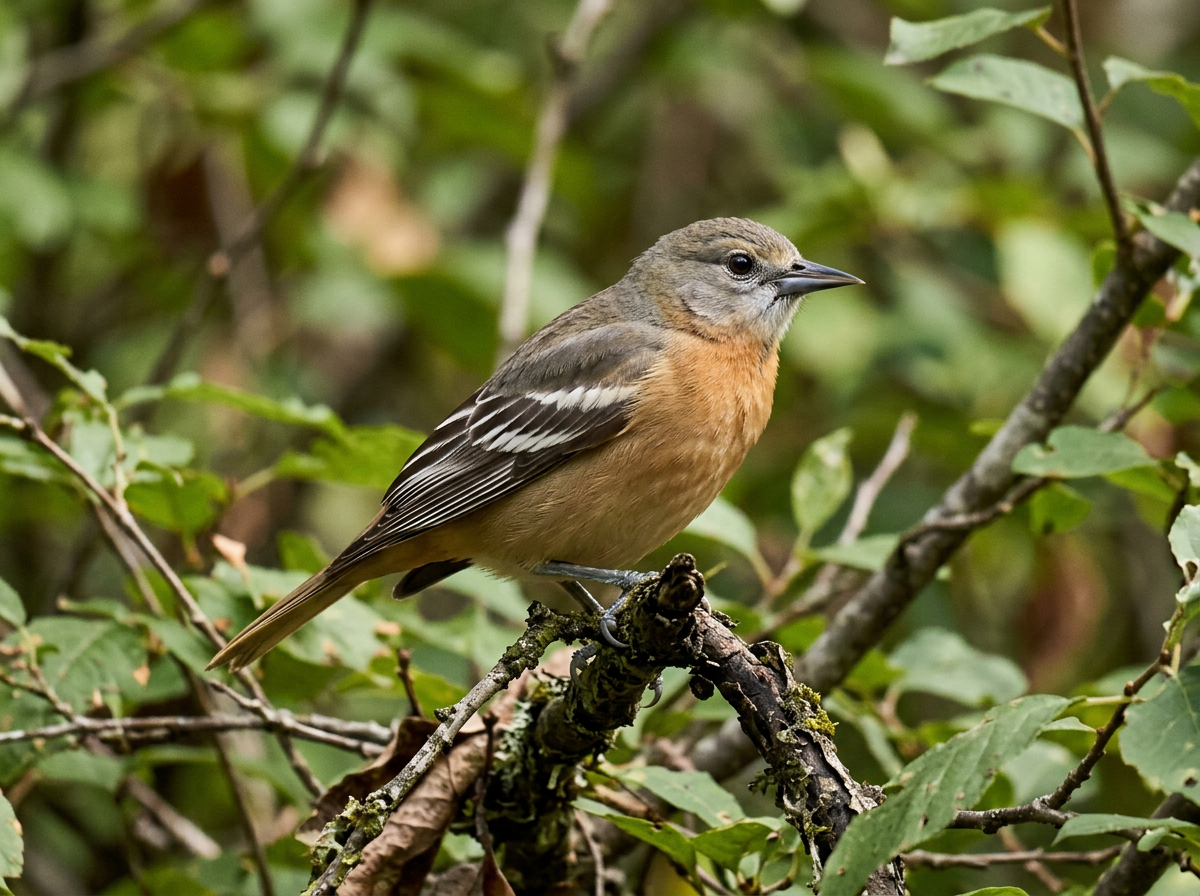
This is probably the most common mix-up. Both are drab, both have white wing bars, and at a quick glance they look interchangeable. The key differences: female Bullock's tends to have a more yellowish-orange head and face, a noticeably grayer back, and a whiter belly. Female Baltimore is more uniformly warm brownish-olive above with a more consistent yellow-orange wash across the underparts. If you're in the western U.S., a Bullock's is much more likely; in the east, Baltimore is your default assumption.
Female Orchard Oriole vs warblers
Female Orchard Orioles are greenish-yellow and small, and they can genuinely look like a warbler at first. The bill is your best friend here: it's noticeably longer and more pointed than any warbler's, and the bird is larger overall. The two white wing bars are also bolder than most warblers show. If the bill looks too long and the bird too big for a warbler, take another look for the Orchard Oriole.
American Robin
Both are orange-and-dark birds of similar size, so a quick glance can fool you. But Robins have an orange-red breast that covers a much larger area, a rounded head with no black hood, a shorter and stubbier bill, and they spend a lot of time on the ground. Orioles tend to stay higher in the canopy, their orange is more vivid, and that pointed bill and black hood (in males) make them look sharply different up close.
Spotted Towhee
Male Spotted Towhees are black-and-orange birds that can briefly confuse people. But a Towhee has a rounder, more sparrow-like body, a much shorter and heavier bill, white spots on the wings (not wing bars), and rusty-orange sides rather than a full orange chest. They also spend most of their time scratching around in leaf litter, while orioles are canopy birds.
Male Baltimore vs male Bullock's
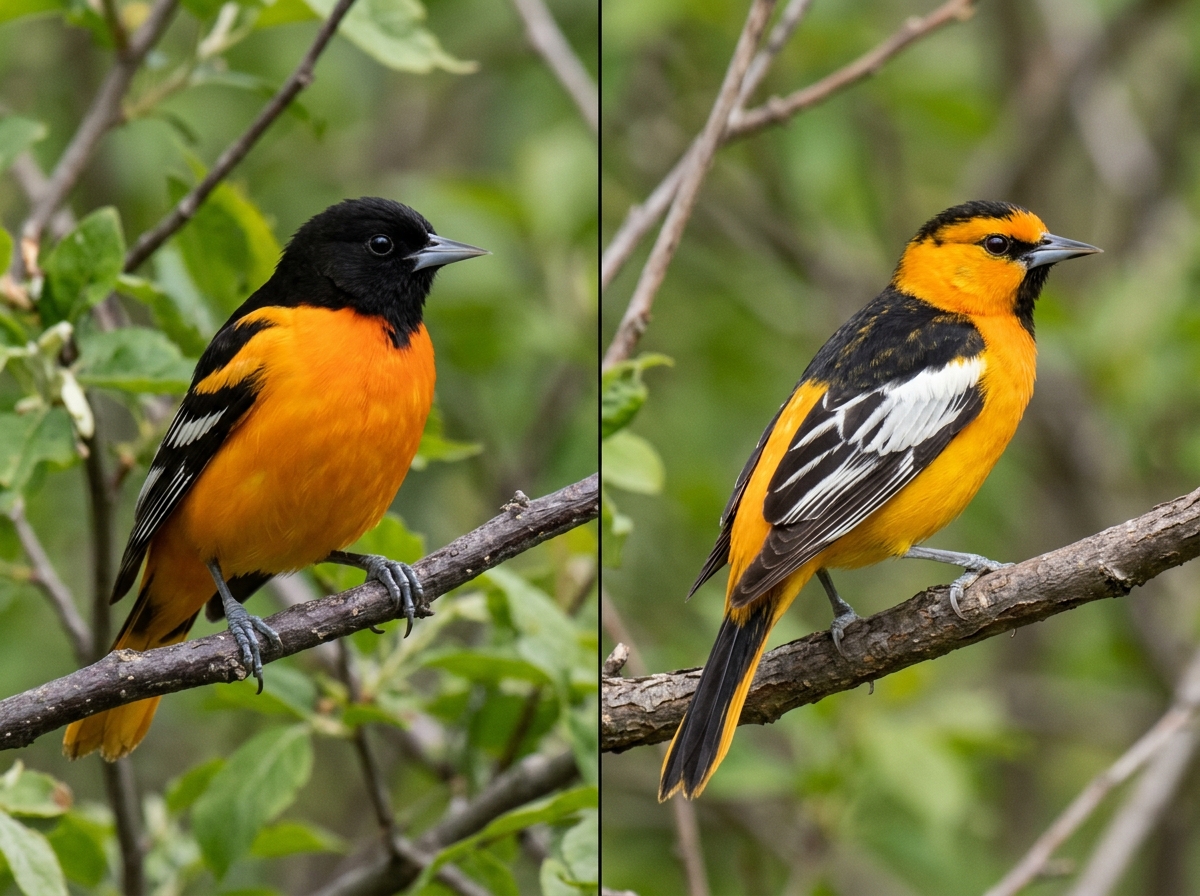
These two are the most visually similar of the male orioles, and they even hybridize where their ranges overlap in the Great Plains. The fastest way to tell them apart: look at the head and wing. Male Baltimore has a fully black head with no orange on the face at all and one narrow white wing bar. Male Bullock's has a bright orange face with a black eye line cutting through it and a large white wing patch instead of a bar. If there's any orange on the face, it's a Bullock's.
How to nail down the ID using your sighting or photo
If you saw the bird briefly or got a blurry photo, start with what you're most sure about. Color is usually the easiest to remember: was it bright orange, muted yellow-orange, or chestnut? Bright orange with a solid black head almost locks in male Baltimore. Chestnut with a black hood locks in male Orchard. Orange face with a black eye stripe points to Bullock's.
If the bird was drab, olive, or yellowish (likely a female or immature), go to the wing bars next. Two bold white wing bars on a warm olive-brown bird: female Baltimore. Yellowish head, gray back, whitish belly with wing bars: female Bullock's. Greenish-yellow all over with two white wing bars and a long pointy bill: female Orchard. Immature males of all three species look similar to the females, just often with a hint of the adult male's patterning starting to show through.
Your location matters a lot here. Baltimore Orioles breed across the eastern and central U.S. Bullock's Orioles are the western counterpart, common in the west. Orchard Orioles are found across the eastern and central U.S. as well, but tend to prefer more open areas and orchards. If you're somewhere in the middle of the country, range alone won't settle it, and you'll need to lean on those field marks. Orchard Oriole specifically, including detailed photo galleries of males, females, and immatures at every age, check out our dedicated guide on what does a butcher bird look like. what does a butcher bird look like
If you're still stuck, the most reliable approach is to photograph or note all of these points together: bill length and shape, head pattern, underpart color, wing bar count and shape, and back color. No single feature always clinches it, but the combination of two or three of them almost always does. Orioles are one of those groups where once you've seen a few clearly, your eye just starts recognizing the family shape and posture automatically, even before you've identified the species.
FAQ
What does an oriole bird look like when it is a female or immature (not a bright adult male)?
If the bird shows little or no black and the colors look muted, you are likely dealing with a female or an immature. In those cases, focus on the wings (how many white wing bars, and whether they are bold and paired), and the overall tone of the back (olive-brown for female Baltimore, grayish for female Bullock’s, greenish-yellow for female Orchard).
What should I look for if I only saw the oriole for a second or two?
A single fleeting view can mislead, especially in females because they share “drab + wing bars.” Before you ID, decide which of these you actually saw: a face color (solid orange face suggests Bullock’s), a black head with no orange/white on the face (male Baltimore), or no black on the head/back plus greenish-yellow overall (female Orchard).
How can I tell the species if the head pattern is hard to see in my photo?
Use wing-bar count and shape as your primary checkpoint when the face is unclear due to angle or lighting. Male Baltimore usually shows one narrow white wing bar, males Bullock’s show a larger solid white patch on the wing, and many females show two distinct white wing bars.
Can lighting or camera settings change what an oriole looks like, and how do I correct for that?
Orioles can look different from distance because orange tones can wash out or look more yellow under shade. If your photo is underexposed, aim to compare relative patterns instead of exact shade: black hood presence, number of wing bars, and whether the orange is concentrated on the face or mostly on the underparts.
How do I distinguish an oriole from a warbler when the bird looks greenish-yellow?
Bill shape becomes especially useful when the bird seems “warbler-like” or “flycatcher-like.” Orchard females are the common confusion, so if you notice a noticeably long, pointed bill (longer and sharper than typical warblers) and the bird seems larger than a small warbler, Orchard Oriole is more likely.
What’s the quickest way to tell an oriole apart from a robin?
Robins can be confusing because they also show orange-red. Check the bill and head first: orioles have a more sharply pointed, longer bill (and male orioles have the black hood on the face), while robins have a shorter, stubbier bill and the orange is spread over a much larger breast area.
What does an oriole bird look like compared with a spotted towhee?
Towhees can resemble male orioles briefly, but they behave differently and have different wing markings. Towhees have a shorter, heavier bill, and their “white” pattern shows as wing spots rather than clean wing bars, plus they usually forage on the ground and in leaf litter.
How can I tell male Baltimore vs male Bullock’s if the photo is blurry?
A male Bullock’s can still look “mostly orange,” but it should have orange on the face plus a black eye line, and the wing often shows a large solid white area rather than a narrow bar. If there is no orange on the face and the head looks fully black, that points away from Bullock’s.
Does behavior (where the bird is feeding) help confirm what an oriole bird looks like?
If a bird is actively feeding in a canopy, that behavioral context supports an oriole ID. Orioles are more often seen higher in trees and shrubs, while many lookalikes (like towhees) tend to spend more time on the ground scratching.
What if I live in a region where multiple orioles occur, and I’m still unsure?
If your location is in the overlap region, don’t rely on range alone. Use a combination of two or three features, specifically bill shape, head pattern, and wing-bar count or patch size, because those are more stable than color perception in different weather and light.
Next Article
What Bird Looks Like a Dragon? Identify Dragon-Like Species
Identify dragon-like birds with key traits, lookalikes, and step-by-step tips to narrow your match fast.